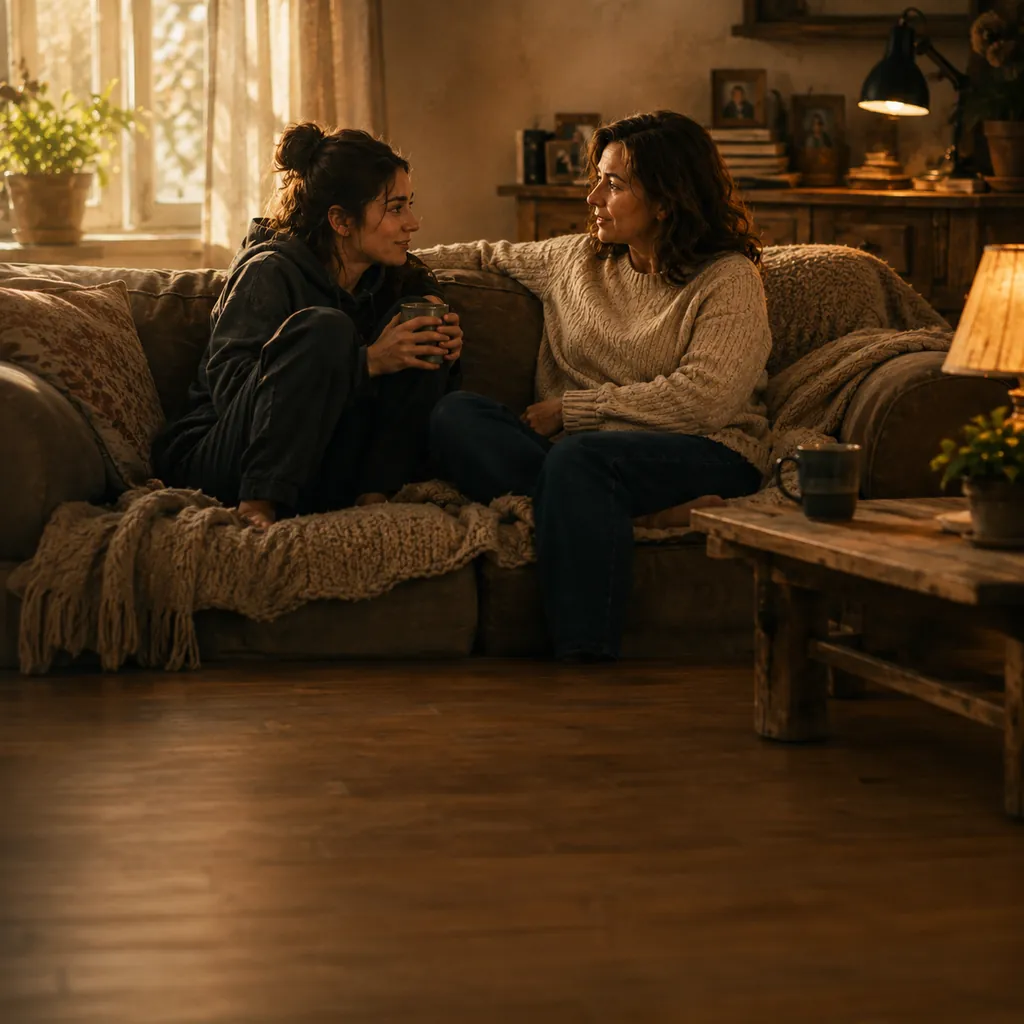
I don’t write about my family because I have things figured out. I write because I spent too many years presenting a version of myself with the rough edges sanded down, and honestly, it made me lonely. When I’m that version, I don’t need anyone. I’m fine. I’ve got it handled.
But that’s not actually who I am. And I suspect I’m not the only one.
What I’ve found, slowly and a little reluctantly, is that the moments I’m most ashamed of are the ones that land with people. Not because we enjoy each other’s failures, but because we recognize them. And that recognition is where real connection lives. When I admit that I was petty, or angry, or that I said the thing I knew I shouldn’t say, someone reads it and exhales. Because they did it too. And for a moment neither of us is alone in it.
And that recognition is where real connection lives.
That’s what I want this to be. Not a confession, not a performance of honesty. Just a real account from a real person who is trying. Imperfect and trying.
If you haven’t read Part One of this story, the short version is this: my daughter struggled through high school with undiagnosed ADHD, and the night she sat on my bedroom floor sobbing was the night I finally stopped trying to fix her and just chose her. I told her she could be done. No diploma was worth her soul. You can read Part One here.
I meant it. I still mean it.
What I didn’t tell you is what happened the morning after.
I woke up angry.
At her. At the situation. Both, honestly, and I didn’t always separate them cleanly.
I still felt, somewhere underneath the decision I’d made, that she hadn’t tried hard enough. I don’t think she was entitled exactly. It was more like she didn’t feel the urgency of it, like she could just set it down and walk away and life would still be waiting for her on the other side. And I kept thinking: you haven’t earned that. You haven’t earned the right to move on.
It felt like she got away with something.
That’s not a comfortable thing to admit. But it’s what I felt, and I think a lot of parents have felt it and called it something more acceptable. Concern. Disappointment. Worry about her future.
I was critical. I was judgmental. I was petty, at times, in ways I’m not proud of. I’d catch myself cataloging everything she wasn’t doing, building a case in my head. I’d make a comment I didn’t need to make. I’d let a silence go longer than it had to. I knew better, and I did it anyway, because knowing better doesn’t automatically make you better.
What started to change it wasn’t a moment. There was no conversation, no single thing she did that flipped a switch. It was more like a discipline I had to take up: choosing, deliberately, to look for what was actually good in her. Not the good I was waiting for, the diploma, the plan, the proof that things were turning out, but the good that was already there, that I kept walking past because it didn’t look like what I expected.
She got a job. She showed up for it. She paid her bills. These are not small things. I kept treating them like they were.
What I had to learn, slowly and against my will, is that what felt like baby steps to me were mountain climbs for her. She was doing something genuinely hard with a brain that had made school, deadlines, and follow-through harder for her than I’d understood. And she was doing it without much fanfare or acknowledgment from me. I was standing there with a mental scorecard, cataloging everything missing, when I should have been looking at everything present.
The softening came when I started to give her credit for what was actually there.
Underneath all of this was a bigger lesson: my kids’ lives are not mine. I knew that. I thought I knew that. But knowing it as an idea is different from living it on a Tuesday when things aren’t going the way you’d have done them. For a long time her choices felt like a comment on mine. I had to learn, over and over, that they weren’t.
She’s doing better now. She’s building something, in her own way, on her own timeline. It doesn’t look like what I pictured. It looks like hers, which I’ve come to understand is the whole point.
I’m still learning to tell the difference between loving someone and needing them to confirm your choices by making the same ones. It’s a finer line than I expected. But I think that’s what the work actually is. Not one big moment of letting go, but a thousand small ones. A comment you decide not to make. A silence you don’t hold. A choice you let belong to someone else.
Her light was never mine to manage. I’m still learning to just let it be.